





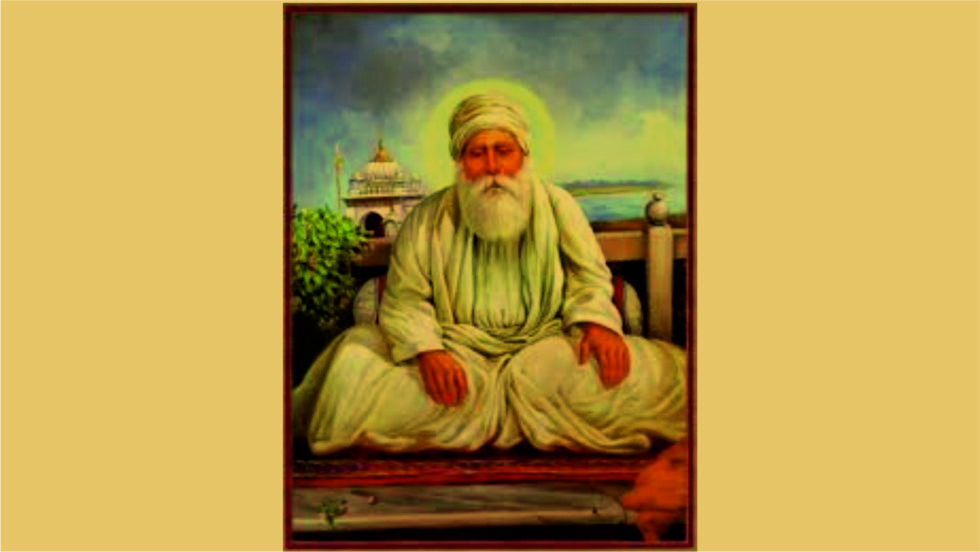
Abstract: This article delves into the profound spiritual and historical journey of Guru Amar Das Ji, the third Sikh Guru. Elaborating on the significance of his life and teachings, it explores the spiritual transformation and societal impact catalyzed by his leadership. Central to this investigation are the Gurudwaras associated with Guru Amar Das Ji’s journey, serving as living monuments to his legacy. Through a comprehensive examination of these sacred sites, the study seeks to unveil the rich tapestry of spiritual wisdom and historical context embedded within, shedding light on the enduring influence of Guru Amar Das Ji’s profound journey on Sikh tradition and beyond.
Guru Amar Das Ji, the third Sikh Guru, played a pivotal role in shaping Sikhism. Born in 1479 AD in Basarke village(1) in present-day Pakistan, he became the third Sikh Guru in 1552 AD at the age of 73, succeeding Guru Angad Dev Ji.
His tenure marked a significant expansion of Sikhism. Guru Amar Das Ji established a hierarchical system of administration within the Sikh community, dividing the territory into 22 manjis(2) (ecclesiastical districts) to facilitate preaching and administration. He also institutionalized langar (community kitchen) as an integral part of Sikhism, promoting equality and service to humanity.
Guru Amar Das Ji’s spiritual teachings emphasized the importance of devotion, humility, and service. He composed several hymns, which were later included in the Guru Granth Sahib, the holy scripture of Sikhism. His most famous composition is Anand Sahib, which reflects the bliss of union with the divine.
He was instrumental in promoting the role of women in Sikh society, abolishing discriminatory practices such as purdah (veiling of women) and sati (widow immolation). He also introduced the custom of Guru ka Langar, a free kitchen where all could eat regardless of caste, creed, or social status, fostering a sense of equality and community.
Guru Amar Das Ji’s legacy extends beyond his spiritual and social reforms.
He laid the foundation for the concept of sangat (congregation) and pangat (egalitarian eating), which remain integral to Sikh religious practices. His contributions helped solidify Sikhism as a distinct faith and laid the groundwork for its future growth and influence. Guru Amar Das Ji passed away in 15743 AD(3), leaving behind a rich legacy of spiritual wisdom and social reform.
Goindwal Sahib
Goindwal Sahib, located on the banks of the river Beas, holds significant historical and religious importance in Sikhism. Founded in 1546 AD by Guru Amar Das Sahib (4), it became a prominent center of Sikh activity during his time.
Goindwal Sahib, founded by Guru Amar Das Sahib in 1546 AD, gained prominence as a vital stop along the ancient east-west trade route crossing the river Beas. The town’s significance further increased when Sher Shah Suri, the Afghan emperor, reconstructed the major road passing through it.
After ascending to the Guruship in 1552 AD, Guru Amar Das Sahib shifted his residence from Khadur Sahib to Goindwal Sahib. In 1559 AD, he initiated the excavation of Bauli Sahib, a large well with 84 steps leading down to its water that became a focal point for pilgrims.
Bauli Sahib: The well, adorned with marble steps and a decorated cupola, attracts pilgrims who come to bathe in its holy waters.
Thara Sahib Guru Amardas Sahib: A marble platform where Guru Amar Das Sahib supervised the excavation of Bauli Sahib.
Langar Guru Amardas Sahib: A large dining hall connected to the kitchen, providing meals to visitors.
Residence of Guru Amardas Sahib: A two-storied building offering accommodation to pilgrims.
Gurudwara Chubara Sahib: Also known as ‘Haveli Sahib’, it served as the residence of Guru Amar Das Sahib and his family, housing a room with a silver palanquin containing Sri Guru Granth Sahib.
Killi Sahib:
A wooden key, now adorned with silver, where Guru Amar Das Sahib used to chant bhajans.
Jyoti Jyoti Asthan Patshahi Third:
A marble site marking the place where Guru Amar Das Sahib passed away.
Chubara Baba Mohan Ji:
Where Guru Amar Das Sahib’s son, Baba Mohan Ji, lived and where Guru Arjan Sahib received the pothis for editing Guru Granth Sahib.
These Gurudwaras are managed under Section 85 of the Act by the Shiromani Gurudwara Parbandhak Committee of Goindwal Sahib. The committee hosts a three-day Jod-Mela annually on the Jyoti-Jyoti Purab of Guru Amar Das Sahib.
Targa
Targa village(5)situated six kilometres northeast of the tehsil town of Kasur in the Lahore district, holds historical significance within the Sikh tradition. Guru Amar Das journeyed to this locale in response to an invitation extended by a Sikh Sangat from Kadivind, an adjacent village. Upon arrival, he established his camp in the jungle approximately one kilometre west of Targa. The devout congregations from Kadivind, Targa, and nearby villages flocked to witness the presence of the Guru and partake in his spiritual teachings. Subsequently, a shrine named Gurudwara First Patshahi Jhari (signifying “bush”) Sahib was erected at this site. An annual religious fair commemorating Baisakhi was a customary observance, fostering communal unity and spiritual renewal. However, the fate of the Gurudwara post-1947 AD remains shrouded in uncertainty, as documented accounts, such as “Sikh Shrines in West Pakistan” published by the Pakistan Government in 1962 AD, do not make any reference to Targa.
Khadur Sahib
Khadur Sahib holds significant historical and religious importance in Sikh tradition, particularly in relation to Guru Angad Dev and Guru Amar Das. It is situated approximately 20 kilometres east of Tarn Taran. The association with the Sikh Gurus traces back to Baba Pheru, the father of Bhai Lehna, who later became Guru Angad. The family settled in Khadur after their native village, Matte di Saran, was destroyed by Mughal invaders. Bhai Lehna, who had served Guru Nanak Dev at Kartarpur Sahib for twelve years, returned to
Khadur permanently upon becoming Guru Angad Dev. Guru Amar Das, the third Sikh Guru, met Guru Angad Dev in Khadur and became his devoted Sikh.
Khadur Sahib is home to six historical Gurudwaras(6),three of which are associated with Guru Amar Das ji.
Gurudwara Tapiana Sahib, located outside the village, is where Guru Nanak Dev stayed and addressed congregations. Bhai Jodha devotedly served him, and later, Guru Angad Dev also preached here. Local tradition suggests that the Bala Janam Sakhi was compiled here.
Gurudwara Darbar Sahib Angitha Sahib, now situated inside the village, marks the cremation site of Guru Angad Dev. Nearby stands a domed marble kiosk known as Killa Sahib or Khaddi Sahib, where Baba Amar Das once stumbled and had a spiritual realization. Adjacent to the Gurudwara is an old well named Bibi Amaro Ji da Khuh, after Guru Angad’s daughter.
Gurudwara Thara Sahib Guru Amar Das is a domed room on a raised platform close to Darbar Sahib, where Baba Amar Das used to relax and meditate when free from serving the Guru.
Basarke Gillan
Basarke Gillan, commonly called Basarke, is situated six kilometers southwest of Chheharta along the Chheharta-Dhand link road. This locale holds historical significance as the ancestral village of Guru Amar Das, who was born(7) here in the year 1479 AD. Bhai Jetha, later known as Guru Ram Das, spent his formative years under the care of his maternal grandmother in Basarke. Notably, Bibi Amaro, daughter of Guru Angad Dev, was married to a nephew of Guru Amar Das and resided in this village. Two prominent Gurudwaras grace the landscape of Basarke:-
Gurudwara Janam Asthan:
This sacred site represents the ancestral home of Guru Amar Das, situated on the site of the former village, which likely met its demise during the tumultuous events of the eighteenth century. Privately managed, this Gurudwara holds significant historical and cultural importance.
Gurudwara Sannh Sahib:
The term “Sannh” refers to a hole made in a wall, often attributed to burglars. This Gurudwara commemorates a significant event in Sikh history when Guru Amar Das faced opposition from Datu, son of Guru Angad Dev, regarding his succession. In response to Datu’s defiance, Guru Amar Das retreated to Basarke, where he secluded himself in a room, issuing a notice warning against forced entry under penalty of a curse. Baba Buddha, upon learning of Guru Amar Das’s whereabouts, ingeniously entered the room through a hole in the wall, thereby avoiding disobedience. This act of reverence and cleverness amused Guru Amar Das, leading to his return to Goindwal to lead the Sikh community. The room sanctified by Guru Amar Das’s meditation and breached by Baba Buddha’s stratagem became revered by Sikhs, leading to the establishment of Gurudwara Sannh Sahib. Sardar Lahina Singh Majithia laid the foundation for this Gurudwara, with subsequent development facilitated by Baba Kharak Singh during the 1950s. Affiliated with the Shiromani Gurudwara Parbandhak Committee (S.GP.C.), this Gurudwara encompasses 150 acres of land and hosts various religious events, including the congregation fair commemorating the death anniversary of Guru Amar Das on the Puranmasi of the lunar month of Bhadon.
Khem Karan
Khem Karan stands as an emblem of historical significance, nestled near the Indo-Pakistan border. Once serving as the terminus for the road and railway line connecting Amritsar with Kasür, its prominence has been underscored by the presence of two venerable shrines dedicated to the Sikh Gurus. Local lore recounts the establishment of a manji during the tenure of Guru Amar Das, led by Bhai Khera, a Shaivite Brahmin who embraced Sikhism. It is believed that Guru Amar Das himself may have traversed(8) through Khem Karan during his journeys to Targa and Kadiwind.
The Gurudwara Thamm Sahib(9), situated near the Kasür Gate, venerates the legacies of Guru Amar Das and Guru Hargobind. Central to its sanctity was a thamm (a wooden beam) reputedly dating back to the Gurus’ era. Sadly, both the thamm and the original edifice succumbed to the ravages of the 1965 Indo-Pakistani conflict. However, a new structure emerged in 1966-67 AD, housing the revered Guru Granth Sahib. Notably, alongside other significant gurpurbs, the commemoration of Guru Amar Das’s death anniversary finds resonance within its walls.
Dalla
Dalla village, situated six kilometres southeast of Sultanpur Lodhi, held significant importance within the Sikh community during the time of Guru Angad Dev and Guru Amar Das. This prominence was chiefly attributed to the leadership of two eminent Sikhs, Bhai Lalu and Bhai Paro(10). Notably, Guru Amar Das himself graced Dalla with his presence, underscoring its spiritual significance. Furthermore, in the year 1604 AD, Guru Arjan Dev honoured Dalla with his visit during the auspicious occasion of his son, Guru Hargobind’s wedding to Mata Damodari, a scion of the esteemed lineage of Bhai Paro.
Gurudwara Nathana Sahib, also known as Gurudwara Sahib Patshahi Teesari, holds significant historical and religious importance, situated amidst the verdant fields approximately 1.5 kilometres distant from the locale of Jand Magholi(11), positioned equidistant between Jand Magholi and Pipal Magholi. Accessible more conveniently via Pipal Magholi, the shrine lies along the Ghanaur-Shambu thoroughfare, with Shambu serving as a pivotal point on the Grand Trunk Road between Ambala and Rajpura.
According to entrenched local lore, Guru Amar Das, in the pursuit of his spiritual odyssey, graced this sacred site with his presence on no fewer than 22 occasions preceding his momentous encounter with Guru Angad Dev, a pivotal event leading to his eventual embrace of Sikhism. Designated as a scheduled Gurudwara under the auspices of the Shiromani Gurudwara Parbandhak Committee (S.GP.C.), it holds the esteemed Serial No. 247 within Schedule I, as delineated in the venerable Sikh Gurudwaras Act of 1925 AD.
The architectural manifestation of Gurudwara Nathana Sahib manifests as a square hall, ensconced upon a broader, square, elevated dais, with the central nucleus housing the sanctum sanctorum, itself square in form. Surmounting this edifice, one finds a square chamber crowned by a pinnacle-bearing dome, emblematic of Sikh architectural tradition.
The congregational fervour at Sangrand occasions draws multitudes of devotees from the neighbouring hamlets, a testament to the enduring spiritual allure of this revered sanctuary. Furthermore, an annual religious convocation coincides with the festivity of Lohri, amplifying the significance of Gurudwara Nathana Sahib as a locus of spiritual communion and cultural celebration within the tapestry of Sikh religious observance.
Kurukshetra
Kurukshetra, situated amidst the confluence of the Ghaggar and Saraswati rivers, delineates a region of profound religious significance, enveloping a township that encompasses various temple complexes, Kurukshetra University,
and administrative headquarters, colloquially referred to as Kurukshetra. Adjacent to this contemporary settlement lies the ancient town of Thanesar. Renowned as a paramount sacred pilgrimage site for adherents of Hinduism, Kurukshetra has historically garnered attention during solar eclipses, attracting a vast congregation comprising Hindu devotees, ascetics, erudites, and laity who converge to partake in purifying ablutions within its expansive sacred reservoir.
Eminent Sikh Gurus, recognizing the sanctity of Kurukshetra, availed themselves of its auspicious occasions, notably during solar eclipses, to promulgate discourses denouncing superstitious observances prevalent among the populace. Among them, Guru Nanak Dev seized such a juncture in the early 16th century to expound teachings against ritualistic dogmas. Subsequently, Guru Amar Das(12), whose erstwhile visits to Kurukshetra as a Hindu pilgrim preceded his embrace of Sikhism, is documented to have journeyed to the site during his pontificate, potentially accompanied by Bhai Jetha, later recognized as Guru Ram Das, circa AD 1553. Further, Guru Hargobind’s pilgrimage to Kurukshetra in 1638 AD during a solar eclipse, and possibly earlier during his transit to Nanak Mata in 1632-33 AD, underscore the enduring significance of the locale within Sikh tradition. Successive Sikh Gurus, including Guru Har Rai, Guru Tegh Bahadur, and Guru Gobind Singh, similarly visited Kurukshetra, where sites commemorating their presence evolved into revered Gurudwaras.
Gurudwara Tisari and Satvin Patshahi hold significant historical and spiritual resonance as they commemorate the legacies of both Guru Amar Das and Guru Har Rai. Situated near Lal Bahadur Shastri Market, on the periphery of Thanesar, this sacred site stands as a testament to the profound teachings imparted by these revered Gurus. Guru Amar Das, in particular, expounded upon the futility of traditional pilgrimages and ablutions in holy waters as means of soul purification. Instead, he emphasized the singular efficacy of “nam” (the Holy Word) as the true pilgrimage, wherein immersion therein offers the ultimate spiritual cleansing. This philosophical stance underscores the primacy of inner spiritual communion over external rituals, encapsulating a profound insight into Sikh doctrine and spirituality.
Haridwar
Haridwar, a renowned Hindu pilgrimage destination situated on the banks of the sacred Ganges River, has historically been frequented by numerous spiritual leaders across various traditions. Within this religious tapestry, the Sikh presence is notable primarily through the sole historical Sikh shrine, the Gurudwara, located at Kankhal(13), close to the Sati Ghat, approximately three kilometres to the south of Haridwar proper. This revered site is dedicated to Guru Amar Das, a significant figure within Sikh tradition, and is meticulously overseen by the Nirmala Sikhs, reflecting the enduring interplay of faith and stewardship within the Sikh ethos.
References:
(1). Narotam, Pandit Tara Singh, (Edi) Mansa, PS, Sri Gur Tirath Sangrah, (1883), Amritsar: Singh Brother, 2022, p 55.
(2.) Teja Singh, Ganda Singh, A Short History of the Sikhs, (Vol:1), Patiala: Punjabi University, 2006, p 23.
(3.)Narotam, Pandit Tara Singh, Sri Guru Tirath Sangrah, op. cit, p 57.
(4.) Sarna, Jasbir Singh, Bedi Daljit Singh, Gurudwara Kosh, Amritsar: Dharam Parchar Committee, 2013, p 157.
(5.)Gurmukh Singh, Major, Historical Sikh Shrines, Amritsar. Singh Brothers, 2005, p 68.
(6.) Sarna, Jasbir Singh, Op. Cit, p 136.
(7.) Harbans Singh, The Encyclopedia of Sikhism, Patiala: Punjabi University, Vol 1, p 62.
(8.) Sarna, Jasbir Singh, op. cit, pp.144-145.
(9.)Gian Singh, Giani, Gurdham Sangrah, Amritsar: Shiromani Gurdawara Prabhandak Committee, p 50.
(10.) Gurmukh Singh, Maj, op. cit, p 133.
11. Ibid., p 179.
(12.) Nabha, Kahn Singh, Gurshabad Ratnakar Mahankosh, Delhi, 1990, p 624.
(13.) Sarna, Jasbir Singh et al, op. cit. p 106.
Dr. Jasbir Singh Sarna
(Sikh Scholar, Historian & Journalist.)
Contact. 099065 66604