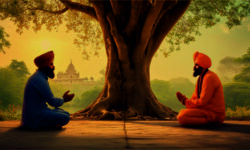






When the British annexed the Khalsa Raj in 1849 and sent the young Maharaja Duleep Singh to England, his mother, Maharani Jind Kaur, was imprisoned in Nepal. Mother and son longed deeply to see each other. On one side was the sorrow of losing a powerful and great kingdom, and on the other, the pain of separation—both unbearable—yet they were helpless.
Like a bird trapped in a locked cage, Maharani Jind Kaur spent her days weeping, remembering her young son. This continued for years, and as a result, she eventually lost her eyesight. She repeatedly pleaded with the authorities to allow her to meet her son at least once.
The British government agreed under certain conditions, but the Nepalese authorities warned that if she left Nepal, her pension would be stopped. Ignoring this, she chose to go. Finally, in 1861, the long-awaited moment arrived when Maharaja Duleep Singh was brought from England to Calcutta, and his mother came from Nepal to meet him.
When they reunited, the blind mother embraced her son and wept bitterly. She blessed him and lovingly placed her hand on his head. But as she touched his head, she suddenly cried out and began to wail in grief. When Duleep Singh asked the reason, she said that losing the kingdom had not caused her as much pain as seeing that he had cut his hair.
She scolded him, cursed her fate, and lamented deeply:
Why had destiny played such a cruel joke on her? Had she not already suffered enough to be subjected to this new pain?
According to her, the loss of the kingdom did not hurt her as much as the loss of her son’s Sikh identity. It shattered her soul. She wished she had never lived to witness such a day.
Maharaja Duleep Singh understood his mother’s pain. He himself was deeply distressed. He explained that when the British took him to England, they forcibly converted him. He was just a child and had no choice, but he never accepted this injustice in his heart. With deep emotion, he said:
“It is true, Mother, that I no longer have my hair, but my Guru still lives fully within me. Bless me so that I may once again adopt the Sikh form and return to the Guru’s path. To me, Sikh identity and Kesh are more important than my kingdom. I promise you that when I get the opportunity, I will take Amrit and become a Singh. This is my first and final wish.”
Hearing her son’s heartfelt words, the mother found some comfort. However, she could not bear her sorrow for long. After reaching England with her son, she passed away.
⸻
Poetic Expression (by poet “Jachak”)
When separated Jinda met Duleep,
The helpless mother cried out in grief,
Seeing no hair tied upon her son’s head.
She broke down completely, shattered within.
Falling at her feet, he said:
“The foreigners have taken me away from Sikhism, Mother.
I will take Amrit and become a true Singh—
I swear this in your presence, Mother.”
⸻
In the remaining years of his life, the sorrowful Duleep Singh made several attempts to escape from England. On one occasion, he even reached Egypt but was captured. According to the book “Dukhiye Maa Putt”, he wrote a letter on 9 March 1886 to his relative Sardar Santa Singh of village Aamma (Amritsar), stating that he would soon return to India, take Amrit from Sardar Thakar Singh Sandhawalia, and fulfill the promise he made to his mother.
However, the British government came to know of his plans. They first threatened him, but he remained unmoved. Then they tried to tempt him by offering to increase his annual pension to 5 lakh rupees if he abandoned his intention to return to India and become a Sikh again. But he was bound by the voice of his conscience.
He once again attempted to travel to India, but the authorities did not allow his plans to succeed. Heartbroken, he eventually died in 1893 in a hotel in France while returning to England, carrying the unfulfilled desire of becoming a Singh in his heart.
⸻
Reflection
See the irony of fate:
Maharaja Ranjit Singh would reward those who wore a beautiful turban with land grants, yet his own son, Maharaja Duleep Singh, despite all his efforts, was never able to wear a turban again in his lifetime.
This entire story deeply shakes our conscience, soul, and mind, reminding us that for a Sikh, Kesh (unshorn hair) and the Dastaar (turban) are as essential as life itself.
⸻
Final Lines
Protect your hair, O brave Singhs!
Preserve your Sikh identity, O brave Singhs!
⸻
— Saroop Singh Alag