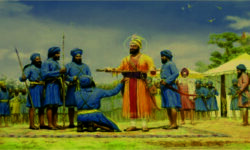






1. Nader Shah’s Prophecy
The plunderer Nader Shah of Kandahar invaded India in 1739. After conquering Delhi, he reached Lahore carrying enormous wealth worth billions, along with thousands of beautiful girls and slaves taken captive.
After collecting one crore rupees as tribute from the Lahore province, while crossing the Ravi River, Sikhs who were hiding in the forests suddenly attacked, looted his treasure, and freed the captive girls and slaves.
Nader Shah summoned Zakariya and asked:
“Who are these attackers?”
Zakariya replied:
“Sir, they are Sikhs. We have tried many times to wipe them out, but they keep reappearing in large numbers and vanish into the forests after looting huge amounts of wealth.”
After a pause, Nader Shah said:
“These Sikhs should not be taken lightly. One day they will rule Punjab.”
A few years later, Sikh rule was established in Punjab, extending from Peshawar to Kashmir and Ladakh.
After Nader Shah left, Zakariya carried out severe atrocities against the Sikhs. Thousands were martyred, and the rest took refuge in the forests. Zakariya sent spies to assess their condition.
The spies reported:
The Sikhs perform kirtan twice daily in the forest. Some prepare food (langar), some groom their horses, some sharpen weapons, some practice shooting, some go hunting. Young Sikhs show respect to elders. Some collect firewood, some fetch water for bathing, some stitch clothes. No one considers himself superior; everyone is treated equally.
Hearing this, Zakariya was astonished.
⸻
2. Qazi Noor Muhammad (1764)
The famous historian Qazi Noor Muhammad came with Ahmad Shah Durrani during his seventh invasion of India. In his war chronicle, he used the term “Sagh” (dog) for Sikhs, yet he wrote:
“Do not call them dogs. They fight like lions. If you want to learn the art of warfare, learn it from them. When they enter the battlefield with swords, they tear through enemy ranks. When they draw their bows, enemies tremble. When they attack with spears, death is certain. One Sikh equals fifty enemies.”
“When they use guns, enemy chests burst and the ground is soaked with blood. Sikh artillery is unmatched.”
“They fight tens of thousands with only small numbers.”
“If Sikhs retreat, do not consider them cowards. It is their tactic. When enemies chase them, Sikhs turn back and annihilate them.”
“They never attack a fleeing enemy. They never harm women. They do not commit adultery or theft. They treat all women as mothers and sisters.”
⸻
3. Pakistani Major General Mukesh Khan (1971 War)
In his book Crisis of Leadership, he wrote:
“Sikhs are extremely brave. They fight with such courage that they defeat much larger armies. A major reason for our defeat was having to face Sikh soldiers.”
He describes a battle where a small Sikh unit stopped an entire Pakistani brigade, shouting:
“Bole So Nihal, Sat Sri Akal!”
They fought hand-to-hand, killed many Pakistani officers, and held their position until tanks destroyed the post. Even then, Sikh reinforcements destroyed the tanks and shattered Pakistani morale along the border.
⸻
4. British Colonel’s Experience
A British colonel once said that during a winter train journey to Amritsar, a poor Sikh offered him his blanket. Later, while he was asleep, the Sikh quietly covered him anyway.
At the Golden Temple, he was treated with great respect, fed in the langar, and given accommodation.
He concluded:
“Sikhs are filled with compassion for others.”
⸻
Final Reflection
Let us look within ourselves and ask:
Are we still the Sikhs created by Guru Gobind Singh?
Are we still following the path of Sikh character and values,
or have we drifted away?
⸻
Summary
This text shows how even foreign invaders, historians, and military leaders admired Sikh bravery, discipline, equality, morality, and compassion. It ends with a powerful call for modern Sikhs to reflect on their own character and remain true to the teachings of the Gurus.
By S. Bakshish Singh Rampura