





The Sikh religion is deeply rooted in both the numinous and historical experiences of Guru Nanak and his nine successors. An analysis of Guru Nanak’s writings makes it abundantly clear that he intensely regarded himself as an instrument of God and conveyed the Divine Will to the people through the medium of his Bani. None of the prevailing religious traditions in India earned his unqualified approval. His critique of the decaying state of contemporary religious orders leaves no doubt that he had no intention of following them. Like a true prophet, he unequivocally challenged the existing social, religious, and political order.
To radically reform society, he denounced the caste system and its associated values. For the establishment of a new world order, he propounded the ideals of the Unity of God and the brotherhood and sisterhood of humankind, which transformed the very fabric of human relationships. Guru Nanak’s successors continued to pursue his mission, which eventually led to the emergence of a new socio-religious dispensation in northern India: the Sikh Panth. This study explores the early markers of Sikh identity that emerged during this formative period.
II
There is no doubt that Guru Nanak’s worldview significantly differed from that of other religious traditions in India at the time. Some scholars mistakenly believe that Guru Nanak was simply one among the medieval Bhagats, concerned primarily with social reform and not with the establishment of a new religion. According to this view, the Sikh Gurus were not concerned with delineating the religious boundaries of Sikhism.
Harjot Oberoi, for instance, argues that early Sikh identity was fluid, amorphous, and unfixed.² However, the identity question can be better understood by examining how the religious experience of a founder unfolds into specific attitudes and expressions. According to Joachim Wach, all religions—despite their diversity—are characterized by three universal expressions: the theoretical (a system of belief), the sociological (a system of social relations), and the practical (a system of worship).³ In his view, until all three elements are present, one may observe religious tendencies or elements, but not a complete religion.
On the basis of this framework, we can analyze early Sikhism to determine whether these three expressions were clearly evident, and thereby define the religious boundaries of early Sikhism.
III: The Theoretical Expression
The system of belief forms the heart or core of any religion. Sikhism, from a theoretical standpoint, is a monotheistic religion. There is no compromise on the Unity of God. The individual’s primary allegiance is to God alone, who is both Transcendent and Immanent, and who responds to sincere prayer. God revealed Himself through the Bani—the Sabad—of the Sikh Gurus.
He is the Creator, and the world is entirely dependent on Him for its existence. Everything except God is transient. While the world is not as real as the Creator, it is also not illusory (Maya) as depicted in traditional Indian philosophy. Salvation does not require asceticism or renunciation of society; liberation (mukti) can be attained through contemplation of the Divine Name in a natural and balanced way, known as Sahaj.
Guru Nanak and his successors rejected the caste system and its supposed divine origin. They affirmed equality and the universal brotherhood of humankind.
A crucial aspect of Sikh theology is the concept of Guruship. Guru Nanak was considered a Divine Preceptor, and his successors were regarded as intermediaries between God and the Sikh community. These Gurus revealed the Divine Will through their Bani. Succession to Guruship was spiritual, rooted in mystical union with the predecessor.
The successors were not merely spiritual heirs but were believed to embody the spirit of Nanak himself—hence the principle of the Unity of Guruship. Though physically distinct, the Gurus were regarded as one in Spirit (Jyoti) and shared the same Divine Light. When writing their Bani, the Gurus used the pen name “Nanak” to emphasize this continuity. Mirza Zulfiqar Ardistani (Mubid Shah), a contemporary of the sixth Guru and author of Dabistan-i-Mazahib, confirmed that the Sikhs believed the spirit of Guru Nanak resided in his successors.⁴
Thus, the core theoretical expressions of Sikh religion were the Unity of God, the brotherhood/sisterhood of humankind, and the Unity of Guruship.
IV: The Practical Expression
No religion can function without a system of worship—its practical expression. This includes liturgy, sacraments, devotional practices, and community rituals. The practical dimension plays a vital role in shaping and preserving a community’s distinct identity. Sikhism, being a revealed religion, shaped its devotional practices according to doctrinal principles.
From the outset, Nam (divine remembrance), Dan (charity), and Isnan (purity)—both internal and external—were central to Sikh life, practiced individually and collectively.
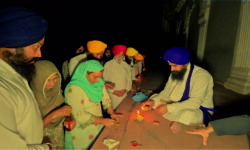
The Dharamsala, a prototype of the modern Gurdwara, was the religious and social hub for early Sikhs. Guru Nanak and his successors established these centers across and beyond Punjab.⁵ These centers included the langar (community kitchen), which provided free food and shelter to travelers and pilgrims. Maintenance of these institutions became a religious duty.
Charity in cash and kind was integral to this system. Guru Arjan institutionalized this practice by formalizing the daswandh (tithe) and appointing masands to collect contributions from Sikhs.⁷
Voluntary service (seva) was elevated by the Gurus to the level of holy worship. Bhai Gurdas records that Sikhs performed tasks like sweeping the Dharamsala, grinding grain, wafting fans over congregants, and dusting shoes with great devotion.⁸
The Dharamsala served as a space for kirtan, recitation of Gurbani, and theological discussions.⁹ Guru Nanak used his own hymns for devotional practices rather than relying on Hindu or Islamic scriptures. Gurbani was central to Sikh worship, and compositions such as Japuji Sahib, So Dar, and Kirtan Sohila became essential parts of the Sikh liturgy.¹⁰
The Gurus chose to use the vernacular Punjabi and developed the Gurmukhi script for recording Gurbani, thereby rejecting the exclusive sanctity of Sanskrit and Arabic.¹¹ Religious services were conducted in Punjabi, further linking the language and script with Sikh identity. Eventually, sacred hymns were compiled into pothis (manuscript collections), culminating in the Adi Granth, installed in 1604 by Guru Arjan at Darbar Sahib, Amritsar—a defining moment in Sikh history.¹²
Sikh customs and festivals evolved independently. Guru Amar Das encouraged Sikhs to celebrate their own festivals, including Vaisakhi and Gurpurabs, as confirmed by Bhai Gurdas.¹³ ¹⁴ During Vaisakhi, entire sangats led by masands would visit the Guru’s court.¹⁵
The Sikh code of conduct (rahit), developed by Guru Ram Das and elaborated by Bhai Gurdas, emphasized daily worship, humility, seva, loyalty to the Guru, and moral discipline.¹⁶ The Sikhs avoided Hindu rituals, mantras, austerities, idol worship, and deities.¹⁷ ¹⁸ Their worship was simple, meaningful, and free of superstition, reinforcing Sikh identity distinct from the Brahmanical tradition.
V: The Sociological Expression
The sociological dimension of religion determines whether its beliefs are socially vibrant and sustainable. It leads to the formation of a community of believers. In Sikhism, the institution of the Sangat (congregation) lay at the heart of community life. Guru Nanak, during his travels, gathered followers and organized them into sangats.¹⁹
A meeting of two Sikhs was called a sadh sangat, and five Sikhs constituted a panj parmeshar—a divine assembly.²⁰ Initially formed by the Gurus, sangats later emerged independently across regions. They were inclusive, accepting individuals regardless of caste, creed, or gender, as long as they upheld the principles of equality and brotherhood.²¹
To manage and connect these communities, the manji and masand systems were introduced by the third and fourth Gurus. Sangats offered voluntary tributes during annual gatherings and supported the Gurus’ missions.²²
The sangat was considered sacred—an embodiment of both the Guru and God.²³ In the Guru’s absence, the sangat functioned as the socio-religious authority, taking decisions for the community.²⁴ This collective and democratic tradition eventually laid the groundwork for the doctrine of Guru Panth.
The evolution of a distinct Sikh social behavior and customs included unique initiation and salutation practices, and life-cycle rituals like birth, death, and marriage, many of which were developed by Guru Amar Das.²⁵ He also promoted a code of conduct that sought to preserve the doctrinal and social independence of Sikhism.²⁶ His code included moral and behavioral norms such as:
• Faith in the teachings of the Guru’s Sikh
• No coveting of another’s spouse
• Avoiding the company of those who distract from the Guru
• Speaking truthfully and reverently
• Observing discipline in personal habits and devotion
Guru Arjan also contributed by formulating Five Do’s and Five Don’ts, or what some call the Ten Commandments of Sikhism.²⁷
The Five Don’ts:
1. Do not steal
2. Do not commit adultery
3. Do not speak ill of others
4. Do not gamble
5. Do not consume liquor or meat
The Five Do’s:
1. Join the sangat regularly
2. Respect and help the humble and needy
3. Arrange marriages for those without means
4. Convert manmukhs (self-willed) to Sikh ideals
5. Pray for the well-being of all humanity
Bhai Gurdas’s Vars further illustrate Sikh social conduct: Sikhs avoided Varna Ashrama Dharma, rejected superstitions, lived moral lives, practiced monogamy, respected women and elders, and participated in communal life through seva, langar, and mutual aid.²⁸
This self-image indicates that early Sikhs had not only broken with Hindu social systems but had also forged their own distinct brotherhood with its own moral, religious, and social codes.
VI: Conclusion
By the early 17th century, the religious experience of Guru Nanak had clearly manifested in theoretical, practical, and sociological expressions. The early Sikhs possessed their own beliefs, rituals, social customs, and moral values. These clearly delineated the boundaries of Sikh identity.
In contrast to Islam and Hinduism, Bhai Gurdas referred to Sikhism using terms like Nirmal Panth, Gurmukh Marg, and Gurmukh Gaadi Rah, highlighting its nature as a new and unique religion.²⁹
Guru Amar Das emphasized this distinctiveness by stating:
“The six systems of the Hindus are prevalent today, but the Guru’s School is unparalleled.
Liberation is attained by absorbing Guru’s philosophy… Through the Guru’s school, the world finds liberation… Guru’s philosophy brings everlasting joy.”³⁰
By the time of Guru Amar Das’s visit to Kurukshetra and Haridwar, the Mughal authorities had exempted him and his followers from the Hindu pilgrimage tax,³¹ marking an official acknowledgment of the Sikhs as a separate religious community.
Minstrels Satta and Balwand, in their Bani, glorified Sikhism as a spiritual empire,³² a movement that included householders rather than ascetics,³³ emphasizing both spiritual and temporal dimensions. The growth of the Sikh Panth, especially under Guru Arjan, saw its expansion across India and an influx of Hindus and Muslims.³⁴ This growth, along with its distinctiveness, provoked Mughal hostility, leading to Guru Arjan’s martyrdom in 1606.³⁵
Clearly, by this time, the Sikh community was not only self-aware of its distinct identity but also recognized by others for its unique religious character.
Notes and References
1. J. Milton Yinger, The Scientific Study of Religion, Collier-Macmillan, London, 1970, pp. 143–150.
2. Harjot Oberoi, The Construction of Religious Boundaries: Culture, Identity, and Diversity in the Sikh Tradition, Oxford University Press, Delhi, 1994, pp. 47–60.
3. Joachim Wach, Sociology of Religion, University of Chicago Press, Chicago, 1944, p. 19.
4. Dabistan-i-Mazahib, an early 17th-century Persian source, devotes a chapter to the Sikhs. The author describes early Sikhs as Nanak-Panthis and also calls them Gursikhs. Translated into English by Dr. Ganda Singh, in The Panjab Past and Present, Vol. I, April 1967, Punjabi University, Patiala. All references hereafter from this work are cited as Dabistan.
5. For instance, during this period, Sikh centres such as Kartarpur (Pakistan), Khadur, Goindwal, Amritsar, Tarn Taran, and Kartarpur (Doaba) were founded by the Sikh Gurus.
6. Varan Bhai Gurdas, ed. Hazara Singh and Bhai Vir Singh, Khalsa Samachar, Amritsar, 1962; Var 11, Pauris 24–31.
7. Dabistan, p. 58.
8. Varan Bhai Gurdas, Vars 6.12; 20.10.
9. Varan Bhai Gurdas, Vars 1.27; 9.17.
10. Varan Bhai Gurdas, Vars 1.38; 26.4.
11. Dabistan, p. 54.
12. Goshti Guru Miharban, ed. Govind Nath Rajguru, Panjab University, Chandigarh, 1969, pp. 79, 91.
13. Balwant Singh Dhillon, “Guru Amar Das and the Mughal State,” Journal of Sikh Studies, Guru Nanak Dev University, Amritsar, Vol. XI, August 1984, pp. 87–95.
14. Varan Bhai Gurdas, Vars 1.27; 9.17.
15. Dabistan, p. 59.
16. Guru Granth Sahib, pp. 305–306; Varan Bhai Gurdas, Vars 6.3; 13; 26.4; 28.15.
17. Varan Bhai Gurdas, Vars 5.6–10; 6.7–8.
18. Dabistan, pp. 50, 51, 57, 63.
19. Varan Bhai Gurdas, Vars 1.27; 24.1.
20. Varan Bhai Gurdas, Var 13.19.
21. Varan Bhai Gurdas, Var 20.7; Dabistan, pp. 57–58.
22. Dabistan, p. 59.
23. Guru Granth Sahib, pp. 317, 1315; Varan Bhai Gurdas, Vars 16.15; 25.25; 39.12.
24. Dabistan, p. 70.
25. Balwant Singh Dhillon, “Guru Amar Das and the Mughal State,” Journal of Sikh Studies, Guru Nanak Dev University, Amritsar, Vol. XI, August 1984, pp. 88–89.
26. Sakhi Guru Amar Das Ki Mahalla 3 is an important source often ignored in discussions on Sikh code of conduct. For the original text, see Narinder Kaur Bhatia, Sri Satguru Ji Ke Muhain Dian Sakhian, self-published, Amritsar, 1978. For the English rendering, see Nripinder Singh, The Sikh Moral Tradition, Manohar Publications, New Delhi, 1990, pp. 102–103.
27. Sakhi Mahalla 5 is found in old manuscripts of the Adi Granth. G.B. Singh located it in a manuscript at Banigram (Eastern Bengal), published as “Sikh Relics in Eastern Bengal,” Dacca Review, Vol. V, 1916; reproduced in The Panjab Past and Present, Vol. I, April 1967, p. 93. English rendering by Nripinder Singh, The Sikh Moral Tradition, p. 103.
28. Points from various Vars: 1.3; 6.12; 7.1; 23.20; 28.18; 29.11.
29. Varan Bhai Gurdas, Vars 1.26; 18.14; 23.1.
30. Guru Granth Sahib, pp. 360–365.
31. Guru Granth Sahib, pp. 116–117.
32. Guru Granth Sahib, p. 966.
33. Surjit Hans, A Reconstruction of Sikh History from Sikh Literature, ABS Publications, Jalandhar, 1988, p. 179.
34. Varan Bhai Gurdas, Vars 11.24; 13.19; Dabistan, p. 57.
35. Tuzuk-i-Jahangiri, trans. A. Rogers, Munshi Ram Manohar Lal, Delhi, 1968, Vol. I, p. 72.
Dr. Balwant Singh Dhillon