






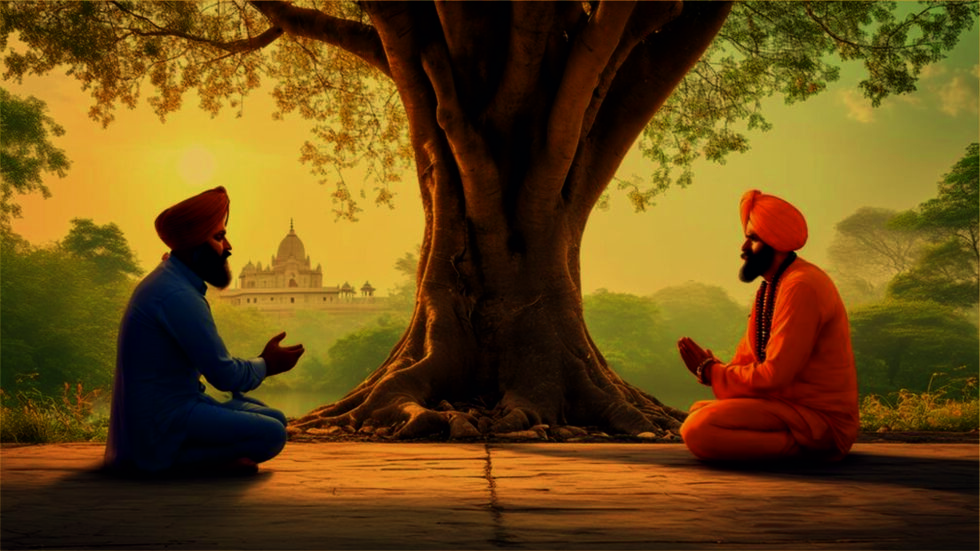
Interfaith understanding and cooperation have never been as urgent as they are today. When we talk about religion, a question naturally arises: Do we have enough religious understanding to foster peace and harmony? Unfortunately, the answer is often no, due to a widespread lack of religious literacy and empathy. Every day, we are confronted with political, ethnic, and religious conflicts across the globe. Human suffering—caused by war, terrorism, poverty, injustice, human rights violations, environmental degradation, and lawlessness—poses a grave threat to global peace.
While all religions promote humanitarian values, humanity today seems confused and disoriented, unable to find lasting solutions to its many crises. Love, equality, and peace have been largely abandoned. The more we attempt to resolve these issues, the deeper we seem to sink into their complexities. Hence, mental peace and spiritual solace have become essential for individuals worldwide to foster an environment of harmony and mutual respect.
To address this need, what is required is quite simple: we must treat others as we wish to be treated ourselves. This calls for meaningful interaction and dialogue, and interfaith understanding can play a vital role by helping us understand the doctrines, beliefs, and practices of others.
Interfaith Dialogue: A Pathway to Harmony
To promote religious harmony today, the most effective way forward is interfaith dialogue. This kind of dialogue does not aim for conversion, subjugation, or the devaluation of any religious tradition. Rather, it offers a common platform for understanding the religious, social, and cultural values of others. In our current lifestyles, especially in multicultural and multi-religious societies, it is imperative that conscious individuals share and exchange their knowledge of each other’s faiths and cultures.
For a peaceful tomorrow in a pluralistic world, it is essential to understand the religio-cultural history of others. We share our lives with people of various beliefs, traditions, and ideologies; this inter-connectedness demands mutual respect and comprehension.
Interfaith dialogue should begin with a deep and sincere study of another person’s or group’s religious beliefs, as every tradition emerges within a specific historical and cultural context. This approach falls under comparative religion, a field that emphasizes objective, historical study. According to modern religious studies, a serious student must explore multiple traditions—one who knows only one religion knows none (1). Without such knowledge, no one can do justice to interfaith dialogue. Genuine cooperation and constructive discussion can only occur when we truly understand others’ faiths in all their dimensions.
In a globalized world of diverse cultures and religious identities, the importance of interfaith dialogue cannot be overstated. We cannot remain indifferent or intolerant to our neighbors, especially in a pluralistic society. The most appropriate and constructive approach to such dialogue is pluralism—an attitude or policy of accepting and respecting religious diversity. Pluralism acknowledges the coexistence of multiple beliefs and embodies a mature, liberal, and humanitarian outlook.
Sikhism: A Model of Pluralism and Dialogue
Sikhism is inherently pluralistic, embracing religious diversity and encouraging peaceful coexistence. It emerged during a time of intense religious conflict and was founded on the ideals of universal love and peace. The Sikh tradition sought to bridge divisions among various faith communities.
Unlike many other medieval movements, Sikhism endured the test of time. Its Gurus recognized the truth present in all religions and supported religious freedom. Guru Nanak Dev Ji, the founder of Sikhism, made extraordinary efforts to foster unity among people of different faiths. His teachings emphasized respect for all religions, and his life is a testament to interfaith openness.
In his seminal composition Japji Sahib, Guru Nanak reflects on the multiplicity of religious beliefs and practices. He preached openness to other traditions and cultures, not exclusion. Though he believed in One God, he showed great respect for those who followed different paths. Guru Nanak also institutionalized his ideals through practices like Langar (community kitchen) and Sangat (spiritual congregation), where all individuals—regardless of religion, caste, or background—could eat and worship together.
Guru Nanak’s Travels and Interfaith Engagement
Guru Nanak undertook four major journeys across the Indian subcontinent and beyond—north, south, east, and west. During these travels, he met diverse religious leaders and communities. His dialogues with siddhas, yogis, and Sufi saints demonstrate a deep engagement with interfaith discourse. For example, in Siddh Goshti, a significant composition in the Guru Granth Sahib, Guru Nanak converses with ascetics and challenges their ritualistic practices with humility and wisdom.
Despite facing hostility, he responded with courtesy, clarity, and compassion, yet remained firm in rejecting superficial religious practices. His goal was to guide others toward the Ultimate Truth without hurting anyone’s sentiments.
When asked how to live amidst the world’s temptations, Guru Nanak replied:
“We should live in the world of maya like a swan swimming in water without getting wet, or a lotus blooming untouched in muddy water.” (3)
This emphasizes detachment within attachment, a core Sikh teaching.
Redefining Yoga: A Practical Philosophy
Guru Nanak redefined the concept of yoga, not as an external ritual but as an inner discipline. He taught:
“Yoga is not in patched garments, or ashes, or shaving one’s head. True yoga is to remain uncontaminated amid worldly temptations and to treat all people as equals.” (5)
He urged ascetics to leave their isolation and serve society. According to him, one must earn an honest living and share with others—a practical spirituality that balances worldly duty and divine connection.
Conclusion: A Call for Global Peace through Dialogue
In Sikhism, social harmony and cooperation are to be achieved through respectful dialogue among faiths. Sikh teachings emphasize the liberation and development of all humanity, not just followers of one religion. The message of the Guru Granth Sahib transcends boundaries of faith, nation, caste, or color. It is not a call for conversion but a foundation for inter-religious dialogue.
To meet today’s global challenges, we must uphold unity in diversity, promote love, practice tolerance, and encourage peaceful coexistence. The Sikh tradition, through its scripture, institutions, and lived values, offers a timeless model for interfaith understanding and global peace.
Dr. Jaspreet Kaur Sandhu
Professor, Dept. of Encyclopaedia of Sikhism, Punjabi University, Patiala