







Abstract: The principle of Panj Pardhan—rooted in the Gurmat concept of collective wisdom and spiritual sovereignty—has played a central role in Sikh theology and history. Epitomized by the formation of the Panj Pyare by Guru Gobind Singh Sahib in 1699, this model of decentralized, divinely guided authority not only sustained the Khalsa Panth during its trials but also served as a moral compass for religious, social, and political decision-making.
This paper explores the evolution of the Panj Pardhani system—from its spiritual conception by Guru Nanak Sahib to its political implications in institutions such as the Dal Khalsa, Sarbat Khalsa, and the Singh Sabha Movement. In light of this tradition, the governance of modern Sikh institutions such as the Shiromani Gurdwara Parbandhak Committee (SGPC) and the Shiromani Akali Dal are critically evaluated. The essay advocates a re-invigoration of the Panj Pardhani ideal as a corrective to the rise of personality cults and centralization within Sikh political structures.
Introduction
The concept of Panch Parvan Panch Pardhan—“the five are approved, the five are supreme”—is not merely a theological construct but a revolutionary framework for egalitarian and collective decision-making in Sikhism. From Guru Nanak Sahib’s articulation of cosmic order through the Five Khands (Guru Granth Sahib, p. 8) to Guru Gobind Singh Sahib’s historic embodiment of this principle in the Panj Pyare, the number five carries sacred authority.
The core of this ideal lies in dismantling authoritarian power structures and replacing them with collective wisdom and accountability—principles that remain highly relevant in today’s fragmented religious and political landscape.
The Spiritual Genesis of Five: From Creation to Khalsa
The foundational notion of a five-fold creation is articulated in the Guru Granth Sahib:
“ਪੰਚ ਪਰਵਾਣ ਪੰਚ ਪਰਧਾਨੁ ॥ ਪੰਚੇ ਪਾਵਹਿ ਦਰਗਹਿ ਮਾਨੁ ॥”
(Panch parvaan, panch pardhaan…)
– Guru Granth Sahib, p. 3
Guru Nanak Sahib envisioned a cosmic framework comprising five progressive realms—Dharam Khand, Gyan Khand, Saram Khand, Karam Khand, and Sach Khand—that represent the soul’s journey toward divine union through ethical, intellectual, spiritual, and mystical evolution.
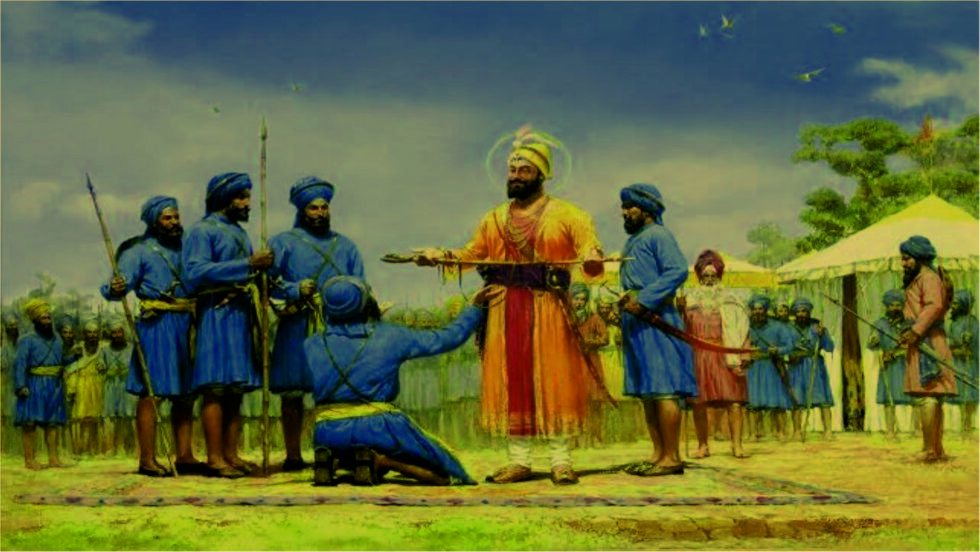
This metaphysical quintet later found its physical embodiment in Guru Gobind Singh Sahib’s institution of the Panj Pyare—five volunteers who symbolized complete submission to divine will. The Guru himself bowed before them, thus inverting the traditional hierarchy and institutionalizing the concept that divine guidance flows through collective conscience.
The Panj Pyare: Living Manifestation of the Guru’s Will
During Vaisakhi 1699, Guru Gobind Singh Sahib formally inaugurated the Khalsa by selecting Bhai Daya Singh, Bhai Dharam Singh, Bhai Himmat Singh, Bhai Mohkam Singh, and Bhai Sahib Singh as the Panj Pyare. As documented in Sri Gur Pratap Suraj Granth by Bhai Santokh Singh, they became the nucleus of Sikh spiritual and political leadership.
These Panj Pyare administered Khande di Pahul (Amrit), led in battle, advised the Guru, and represented the collective voice of the Sangat. They were living embodiments of decentralized, consultative spiritual governance.
Even prior to 1699, groups of five held significance in Sikh tradition. Bhai Kahn Singh Nabha, in Mahan Kosh (1990, p. 79), mentions Guru Arjan Sahib’s trusted circle of five Sikhs, including Bhai Bidhi Chand. Similarly, Bhai Rattan Singh Bhangu, in Pracheen Panth Prakash, writes:
“ਜਿਥੈ ਪੰਜ ਭੁਜੰਗੀ ਹੋਇ ॥ ਊਥੈ ਜਾਣੋ ਗੁਰਦੁਆਰਾ ਸੋਇ ॥”
(Wherever five Singhs gather, consider that place a Gurdwara.)
This underscores the belief that the presence of five Gurmukhs constitutes divine legitimacy—socially, politically, and spiritually.
Historical Continuity of the Panj Pardhani Framework
The Panj Pardhani principle has permeated Sikh institutions across centuries:
• The Dal Khalsa and Sarbat Khalsa were governed through resolutions passed by Panj Pyare.
• Military Panchayats during the Sikh Confederacy appointed five advisors per unit to ensure discipline and decentralized command.
• The Singh Sabha Movement (1873–1920s) was led by five central figures—S. Thakur Singh Sandhawalia, Prof. Gurmukh Singh, Giani Ditt Singh, S. Maya Singh, and S. Jawahar Singh—who collectively revitalized Sikh identity.
While Jean-Jacques Rousseau proposed his Social Contract in 1762 and Karl Marx co-authored the Communist Manifesto in 1848, Guru Gobind Singh Sahib had already implemented a democratic and divinely inspired egalitarian order more than a century earlier.
The Shiromani Akali Dal and SGPC: A Crisis of Centralization
Founded in 1920, the Shiromani Akali Dal emerged as a political expression of Sikh will to regain control of Gurdwaras. Closely linked to the Shiromani Gurdwara Parbandhak Committee (SGPC)—often referred to as the “Parliament of the Sikhs”—these institutions were meant to reflect the collective spirit of the Panth.
However, over time, leadership in these institutions has become presidential and personality-driven, contradicting the Gurmat-based Panj Pardhani ethos. The dominance of individual or family-based leadership undermines the founding principle of collective spiritual governance.
In major decisions—such as defining Sikh conduct (Rehat Maryada), pronouncing Tankhah (penalty), or issuing Hukamnamas—authority should rest not with a single figure but with a Panj Pyare–like council, representative of the Sangat.
A reformed Akali Dal should adopt this model, selecting five virtuous, learned, and publicly accountable Sikhs through consensus. This Panj Pardhani core should guide policy, resolve disputes, and restore the party’s theological and historical integrity.
Conclusion: Reviving the Divine Republic
The Panj Pyare are not merely ceremonial figures; they represent a living template of divine democracy—instituted to preserve the sanctity of Sikh principles and to guide collective action. As Bhai Prahlad Singh states in his Rahitnama:
“The Guru Khalsa is considered to be the body of the manifested Guru.”
The time has come to re-institutionalize the Panj Pardhani ideal, not just in religious forums like the Takhts and SGPC, but also in sociopolitical platforms like the Akali Dal. By transitioning from personality-led to panthic-led leadership, the Sikh community can reclaim its historical legacy of divine equality, justice, and collective wisdom.
“The true Khand resides in the Nirankar.”– Guru Granth Sahib, p. 8
In an age of fragmentation and centralization, the sacred collective of the Panj Pyare remains the lighthouse of unity, humility, and accountability.
⸻
References
1. Guru Granth Sahib, pp. 3, 8, 736, 1041
2. Bhai Kahn Singh Nabha, Mahan Kosh, 1990, p. 79
3. Bhai Santokh Singh, Sri Gur Pratap Suraj Granth, Ansu 23
4. Bhai Rattan Singh Bhangu, Pracheen Panth Prakash
5. Bhai Prahlad Singh, Rahitnama
6. Bhai Chaupa Singh, Rahitnama
7. Saroop Das Bhalla, Mahima Prakash, 1773
8. Proceedings of Sarbat Khalsa and Military Panchayats
9. Secondary literature on the Singh Sabha Movement
By Jasbir Singh Sarna